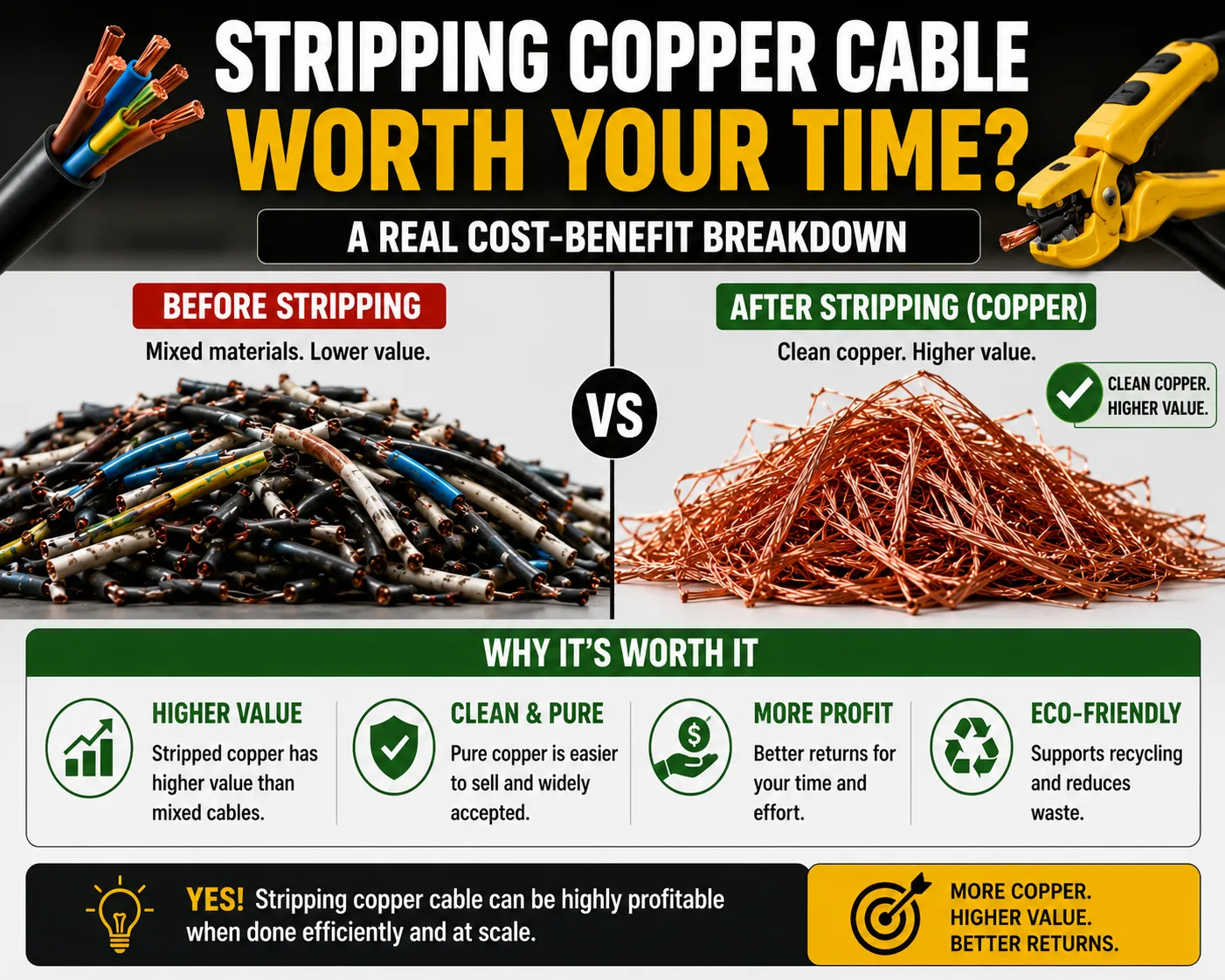
It’s one of the most debated questions in the copper recycling Sydney community – among electricians, demolition contractors, and DIY renovators alike. You’ve got a pile of insulated copper cable. You’ve heard that bare copper pays significantly more than insulated. But is the time spent stripping it actually worth it?
The honest answer: sometimes yes, often no, and it almost always depends on factors most guides don’t bother to spell out. Here’s a real cost-benefit breakdown.
Understanding Copper Grades and Why They Matter
Before the maths, you need to understand the grading system used by copper recycling Sydney yards. The price gap between grades is the entire basis for whether stripping makes financial sense.
Bare Bright Copper – The highest grade. Uncoated, unalloyed copper wire, typically 16 gauge or thicker, with no insulation and no oxidation (the bright in the name matters). This is what you get from freshly stripped, clean cable.
#1 Copper (Heavy) – Bare, uncoated copper free from excessive oxidation. Includes thicker pipe sections, bus bars, and stripped wire with minor tarnishing. Slightly below bare bright.
#2 Copper – Includes oxidised, painted, or coated copper. Thinner gauge wire, mixed grades. Noticeably lower price per kg than #1.
Insulated Copper Wire (Light/Heavy) – Priced based on the estimated copper content within the insulation. The recycler factors in the weight and type of insulation when calculating your payout. This is typically the lowest per-kg return for any copper-containing material.
At a Sydney copper recycling yard, the price spread between insulated copper wire and bare bright copper is typically $2–$5 per kilogram. This spread is the number everything else hinges on.
The Real-World Maths: Three Scenarios
Scenario 1: The Electrician’s Off-Cut Pile
What you have: 20kg of mixed 2.5mm and 4mm TPS cable offcuts from a residential job. Standard twin-and-earth with PVC insulation.
As insulated: At $3.50/kg (a typical Sydney rate for light insulated copper), that’s $70.
Stripped: TPS cable at 2.5mm is approximately 40–45% copper by weight. So 20kg of cable contains roughly 8–9kg of copper. At $9/kg for bare bright, that’s approximately $77–$81.
Gross gain from stripping: $7–$11
Time to strip 20kg of TPS by hand: 2–3 hours minimum. TPS is notoriously fiddly to strip manually — the flat twin-and-earth format requires cutting and peeling rather than simple pulls.
Verdict: Not worth it. You’re earning less than $5/hour for your time. Sell it as insulated.
Scenario 2: The Demolition Find – Heavy Single-Core Cable
What you have: 30kg of 6mm and 10mm single-core cable, the type commonly found in switchboard runs and sub-mains. Old PVC insulation, relatively easy to strip.
As insulated: Heavy insulated copper wire at $4.50/kg = $135
Stripped: Single-core 10mm cable is approximately 65–70% copper by weight. 30kg yields roughly 19–21kg of copper. At $9/kg bare bright: approximately $171–$189
Gross gain from stripping: $36–$54
Time to strip 30kg of single-core 10mm: With a good cable stripping tool (manual bench stripper or electric stripper), 45–60 minutes is realistic.
Verdict: Worth it — particularly with a mechanical stripper. You’re earning an effective $36–$72 per hour for your time on the stripping component.
Scenario 3: The Large Commercial Haul — Mixed Cable
What you have: 200kg of mixed cable from a commercial fit-out — ethernet, data cable, thin multicore, some heavier single-core runs.
The complication: Thin data and ethernet cable is very low copper content — often 10–20% copper by weight. Stripping it manually is extremely time-consuming relative to the copper recovered. Heavy single-core sections are worth stripping; thin data cabling generally is not.
Practical approach: Sort first. Separate the heavy single-core cable (worth stripping) from the thin data and multicore (sell as mixed insulated). Even basic sorting significantly improves your return without full stripping.
Verdict: Selective — strip the heavy cable, sell the rest as-is.
The Hidden Costs Most Guides Ignore
Your Time Has a Floor Value
If you’re an electrician charging $120–$150/hour on the tools, your stripping time has a clear opportunity cost. Spending 3 hours stripping cable that nets you $15 extra is a poor business decision — even if the stripping itself “makes sense” on paper. Factor in your actual time value.
Stripping Tool Investment
A quality manual cable stripper (Ideal Industries, Knipex) runs $80–$200. An electric bench stripper suitable for volume work is $300–$800+. If you’re doing this regularly, the tool pays for itself quickly. If you’re doing it once from a home renovation, borrowing or hiring makes more sense than buying.
Disposal of Insulation Waste
Stripped PVC insulation is not easily recyclable in most Sydney council areas. You’ll need to dispose of it as general waste, which may mean landfill fees or a larger general waste bin. For large volumes, this is a real cost to factor in.
Occupational Health
Long periods of manual cable stripping are repetitive strain territory. If you’re doing this commercially, ergonomic tool selection and volume limits per session matter for long-term hand and wrist health.
When Stripping Is Almost Always Worth It
Large gauge, single-core cable in long runs The copper recovery rate is high, stripping is fast, and the price differential is maximised. This is the sweet spot for copper recycling in Sydney.
When you already have an electric stripper The time equation changes dramatically with mechanical assistance. A job that takes 3 hours by hand takes 30 minutes with a quality electric stripper. The same volume becomes highly worthwhile.
When you’re holding for a price upswing If copper prices are currently low on LME and you have storage space, stripping your cable now and holding clean bare bright copper for a price recovery can be a smart strategy for commercial-volume sellers.
When the insulated copper payout rate at your local yard is particularly low Payout rates for insulated copper vary more between Sydney yards than bare bright rates do. If one yard is paying notably below market for insulated cable, the differential makes stripping more financially attractive.
When Stripping Is Almost Never Worth It
Thin gauge multicore, data cable, or ethernet Low copper content, time-consuming to strip, poor return on effort regardless of method.
Small volumes (under 5kg) The absolute dollar difference is too small to justify any meaningful time investment.
When you’re quoting or billing at your professional rate For working electricians or contractors, the opportunity cost calculation almost always favours selling insulated and spending your time on billable work.
When cable contains asbestos or unknown hazardous materials Old cables from pre-1990 buildings — particularly in commercial or industrial settings — may contain asbestos insulation. Never strip unknown old cable without identification. Bring it to a copper recycling Sydney yard and disclose its origin; they can advise on safe handling.
Maximising Your Return Without Full Stripping
Even if full stripping isn’t worth your time, there are ways to improve your copper recycling Sydney payout:
Sort by grade — separate heavy from light insulated cable. Most yards pay different rates for each.
Remove non-copper components — plugs, connectors, fuse holders, and junction boxes are typically a different (lower-value) material. Remove them before weighing.
Coil and bundle neatly — tangled, mixed loads take longer to sort and assess. Yards that need to spend time sorting your load factor this into the offer.
Shop the rate — call two or three copper recycling Sydney yards on the same day. Rates for insulated cable vary more than rates for clean bare bright, so shopping around has more impact for mixed loads.
Frequently Asked Questions
Is it legal to strip copper cable in NSW? Stripping copper cable that you legally own is entirely legal. The legal restrictions in NSW relate to possession of stolen copper or wire — the Scrap Metal Industry Act 2016 requires licensed dealers to verify seller identity and maintain records. Any legitimate copper recycling Sydney yard will ask for ID.
Does stripping cable affect GST treatment of the sale? If you’re selling copper as part of a business activity, GST rules around scrap metal sales apply. Consult your accountant — the ATO has specific guidance on the reverse-charge GST mechanism that applies to scrap metal sales between GST-registered entities.
What’s the best manual cable stripper for occasional use? For occasional use on standard TPS and single-core cable, a basic rotary stripper like the Knipex 16 60 100 or a simple bench-mount pull-through stripper handles most residential electrician cable types reliably.
Does the time of year affect copper prices in Sydney? Yes — see our guide on timing your scrap metal sale. Copper prices are globally driven and can shift week to week based on LME movements, Chinese demand, and the AUD/USD rate.
The Bottom Line
Stripping copper cable is worth your time when you have large-gauge, high-copper-content cable, access to a mechanical stripper, and a real dollar differential that justifies the effort. It’s not worth your time for thin data cable, small volumes, or when your own professional time has a high opportunity cost.
The smarter move for most Sydney sellers — particularly electricians and contractors — is to focus on sorting and grading rather than stripping everything. Getting paid the correct grade rate for your heavy insulated cable is often more valuable than the time spent stripping, and it takes minutes rather than hours.
Want a current quote for your copper load? Contact Safari Copper Recycling for today’s Sydney copper recycling rates — we accept insulated and stripped copper across all grades.